
Every clinical trial begins with a scientific question. But behind every protocol, every visit, every laboratory result and every data point is a person who has placed their trust in research.
On World Patient Safety Day, OrciVita Sciences & Research Pvt. Ltd. reaffirms a principle that guides our clinical operations every day: the rights, safety, dignity and well-being of research participants must always come first.
For us, patient safety is not an activity limited to adverse event reporting. It is a continuous responsibility that begins before the first participant is screened and continues until the study is completed, closed and appropriately archived.
Patient Safety Begins Before Recruitment
Safe clinical research starts with preparation.
Before a study begins at a site, our teams work closely with investigators and site personnel to understand the protocol, eligibility criteria, investigational product or device, safety requirements, visit schedules and study-specific procedures.
Site feasibility and preparedness are assessed carefully. During study initiation, teams are trained on the protocol, informed consent process, safety reporting requirements, documentation standards and participant management.
The objective is simple: identify potential risks before they can affect a participant.
Informed Consent: Respecting the Patient’s Right to Decide
Participation in clinical research must always be voluntary and informed.
OrciVita emphasizes an appropriate informed consent process in which potential participants are given adequate information about the study, its procedures, foreseeable risks and benefits, available alternatives and their rights as research participants.
Consent is more than a signature on a document. It is a process of communication, understanding and respect.
Participants must also understand that they have the right to ask questions and to withdraw from a study in accordance with applicable requirements without compromising their dignity or appropriate medical care.
Safety Through Appropriate Patient Selection
Eligibility criteria exist for scientific as well as safety reasons.
Our clinical operations teams support investigators in careful screening and verification of inclusion and exclusion criteria before enrolment. Relevant medical history, concomitant medications, laboratory parameters and other protocol-defined assessments are reviewed and documented as required.
This helps ensure that participants are enrolled appropriately and that avoidable risks are minimized.
Vigilance at Every Patient Visit
Patient safety does not stop after enrolment.
Throughout a study, our site teams support protocol-compliant patient visits, scheduled assessments, follow-up requirements and documentation.
Clinical findings and potential safety concerns are brought to the investigator’s attention, while adverse events and serious adverse events are documented, followed up and reported within applicable timelines according to the protocol, regulatory requirements and study procedures.
Timely recognition. Accurate documentation. Appropriate escalation. Continuous follow-up.
These are fundamental components of responsible clinical trial conduct.
Protocol Compliance Protects Patients
A protocol is not merely an operational document. Many of its requirements are designed specifically to protect participants.
Visit windows, laboratory assessments, dose modifications, prohibited medications, discontinuation criteria and safety monitoring requirements can all have direct implications for participant well-being.
Our clinical operations teams therefore focus strongly on protocol adherence while identifying, documenting and escalating deviations when they occur.
Quality Data Supports Patient Safety
High-quality clinical data and patient safety are closely connected.
Incomplete documentation, delayed data entry or unresolved discrepancies may affect the ability of investigators and sponsors to identify safety trends.
OrciVita emphasizes timely source documentation, EDC entry, query resolution, reconciliation and quality review so that study data accurately reflect what happened to the participant.
Our dedicated Quality Assurance and Quality Control processes further strengthen oversight by identifying gaps, supporting corrective and preventive actions, and encouraging continuous improvement across clinical operations.
Investigational Product and Device Accountabilit
Proper handling of investigational products and medical devices is another important component of participant protection.
Our teams support sites with appropriate receipt, storage, temperature monitoring, dispensing documentation, accountability, reconciliation and return or destruction procedures according to study requirements.
Any discrepancy or excursion requiring evaluation is escalated through the appropriate study channels.
Ethics and Regulatory Compliance
Ethics Committees play a critical role in protecting research participants.
Our regulatory and clinical operations teams facilitate timely submissions of study documents, amendments, safety information, protocol deviations and other required communications to Ethics Committees and relevant stakeholders.
We believe that ethical oversight should never be treated merely as an administrative requirement. It is an essential safeguard for the people participating in research.
Patient Safety Is a Team Responsibility
No single person can ensure patient safety alone.
It requires collaboration between participants, investigators, study coordinators, Ethics Committees, sponsors, CROs, laboratories, pharmacists, monitors, safety teams and regulatory authorities.
At OrciVita, we therefore work to create a culture where team members are encouraged to identify concerns early, communicate clearly, escalate appropriately and learn from deviations and safety events.
From Compliance to Culture
Regulations, SOPs and checklists provide the framework for safe clinical research. But true patient safety requires something more—a culture of responsibility.
It means asking at every stage:
Is the participant adequately informed?
Is this procedure necessary and protocol compliant?
Has a potential safety concern been identified?
Has it been communicated to the right person?
Is the documentation complete?
Have we followed up appropriately?
When these questions become part of everyday clinical operations, patient safety moves beyond compliance and becomes part of organizational culture.
Our Commitment
Having supported 60+ clinical trials across multiple therapeutic areas and sites, OrciVita continues to strengthen its systems, people, training and quality processes with one central objective: conducting research responsibly while protecting the people who make medical advancement possible.
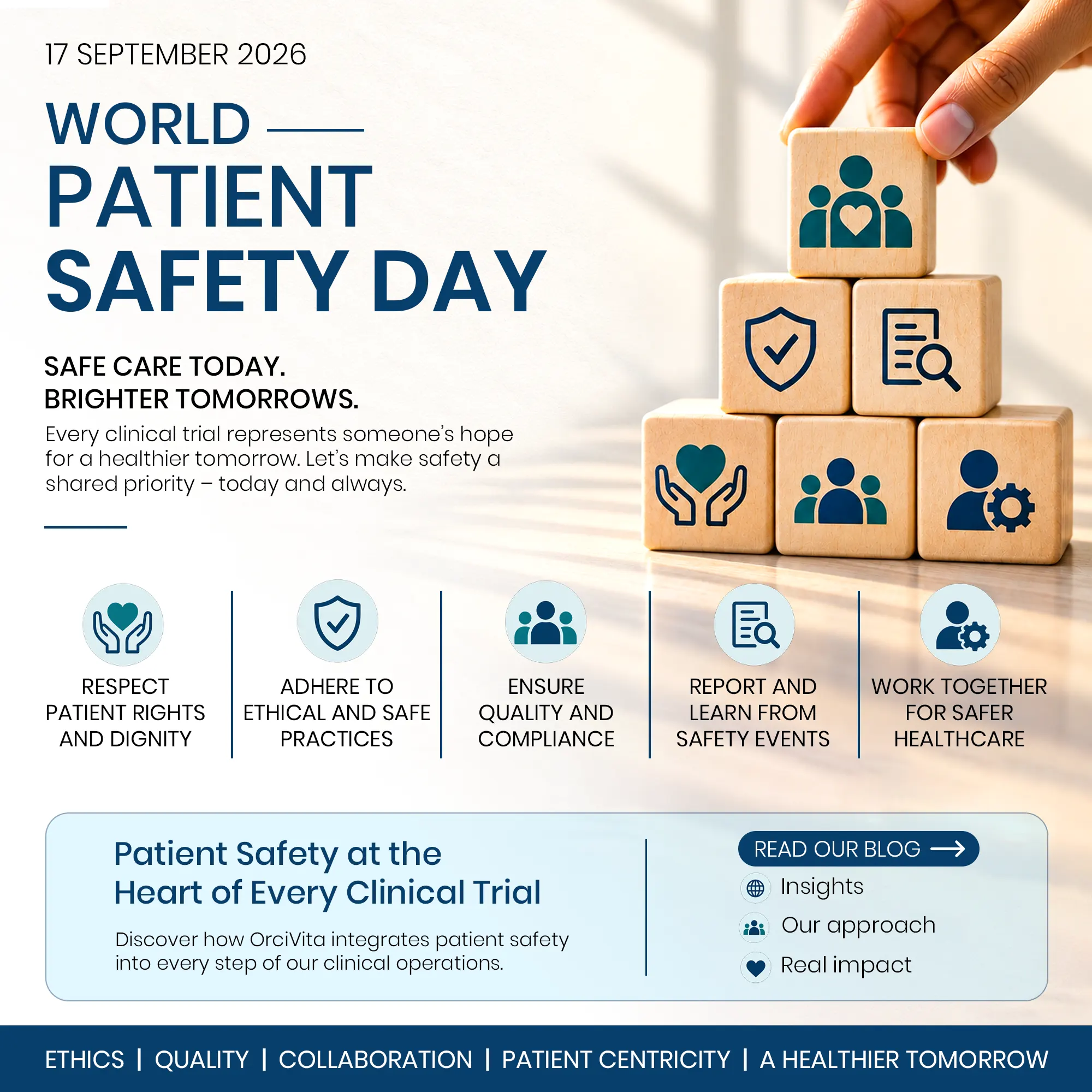
This World Patient Safety Day, we reaffirm our commitment to:
Respect patient rights and dignity.
Conduct ethical and responsible research.
Recognize and report safety concerns promptly.
Maintain quality and regulatory compliance.
Promote transparency and accountability.
Continuously train our clinical research teams.
Keep patients at the centre of every decision.
Because clinical research is ultimately not just about generating evidence.
It is about generating evidence responsibly.
And behind every data point is a person who has placed their trust in research.
OrciVita Sciences & Research Pvt. Ltd.
Research for a Healthier Tomorrow
People. Science. Better Tomorrows.